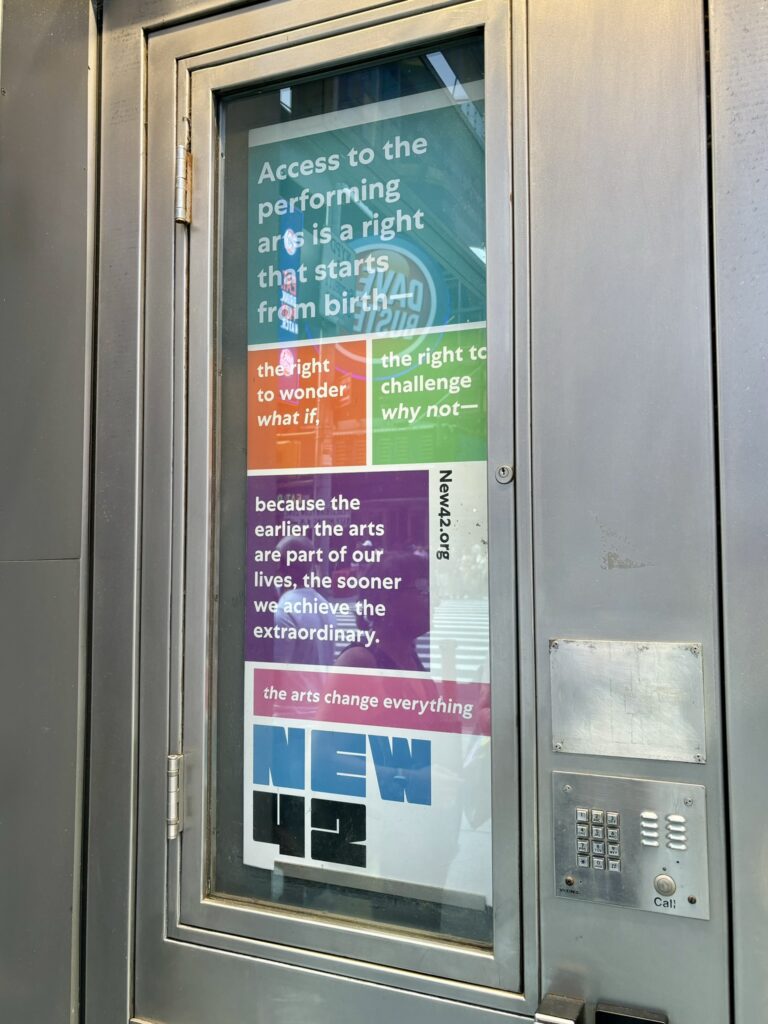
Walking along Manhattan’s 42nd Street, I stumbled across a message that stopped me in my tracks. It sits outside the New 42nd Street building and reads:
“Access to the performing arts is a right that starts from birth — the right to wonder ‘what if?’, the right to challenge ‘why not?’ — because the earlier the arts are part of our lives, the sooner we achieve the extraordinary.
The arts change everything.”
It’s a bold statement — and a beautiful one. More importantly, it is clear, inclusive and generous. It reflects the organization’s values instantly, even for people who never step inside.
In many ways, this is what mission statements in cultural organizations should aspire to be.
Mission statements should welcome, not exclude
It’s easy for mission statements to become abstract. They may drift toward internal language, assumed knowledge or sector-specific jargon. However, when that happens, we risk doing the opposite of what we intend. We may accidentally distance the very people we want to reach.
The New 42’s message avoids that trap. It:
- speaks directly to people rather than at them,
- avoids elevated or exclusive language,
- frames the arts as something belonging to everyone,
- celebrates imagination and possibility,
- avoids gatekeeping entirely.
In other words, the message reflects a worldview rather than a slogan. It’s an invitation.
What this reveals about audience connection
Clear, open language signals that your venue is for everyone. Moreover, it helps audiences, artists, community members and visitors see themselves within your mission. That is essential for building trust and for inspiring participation.
This is particularly important for new or hesitant audiences. For someone lacking familiarity with performing arts venues, ambiguity can feel like a barrier. Therefore, an inclusive mission statement can make a meaningful difference by:
- reducing intimidation,
- increasing confidence,
- clarifying purpose,
- and creating a sense of belonging before a visitor even walks through the door.
Why this matters for organizational culture too
Mission clarity is not only external. When a mission resonates internally, it:
- guides decision-making,
- supports alignment across teams,
- reinforces shared priorities,
- and helps staff tell the story of their organization in an authentic way.
Yet, when missions feel vague or overly formal, staff may not feel connected to them. As a result, the mission becomes something on a website rather than something that lives in the culture.
On the other hand, when mission language is simple, accessible and energizing, it becomes a tool that helps everyone articulate why the work matters.
How to evaluate your own mission and messaging
If you’re revisiting your mission statement — or planning to — here are questions that can help:
- Is the language clear? Could someone from outside the arts understand it instantly?
- Is it inclusive Does it reflect diverse audiences and experiences?
- Does it welcome people in? Or does it unintentionally create distance?
- Does it reflect not only what you do, but also what you believe?
- Is it something your team can confidently say aloud? If not, why not?
- Does it evoke emotion, purpose or possibility? Clarity does not mean flatness — it means resonance.
What the arts teach us about simplicity
The arts are often described as complex, layered and nuanced. However, the messages that introduce people to the arts do not have to be. In fact, the simpler and more universal the message, the more powerful the impact.
The New 42 message succeeds because it tells a truth we can all relate to — that the arts help us imagine, question and grow. It invites people into a shared human experience rather than positioning culture as something rarefied.
It’s a reminder that accessibility begins with language.
Why this matters to us at Artifax
At Artifax, we support organizations whose missions are rooted in creativity, equity and community connection. Clear, inclusive messaging helps deepen that connection. Moreover, it helps teams communicate more effectively, collaborate more confidently and align operations with purpose.
We believe the arts change everything too — and we’re proud to support the people who make that work possible.