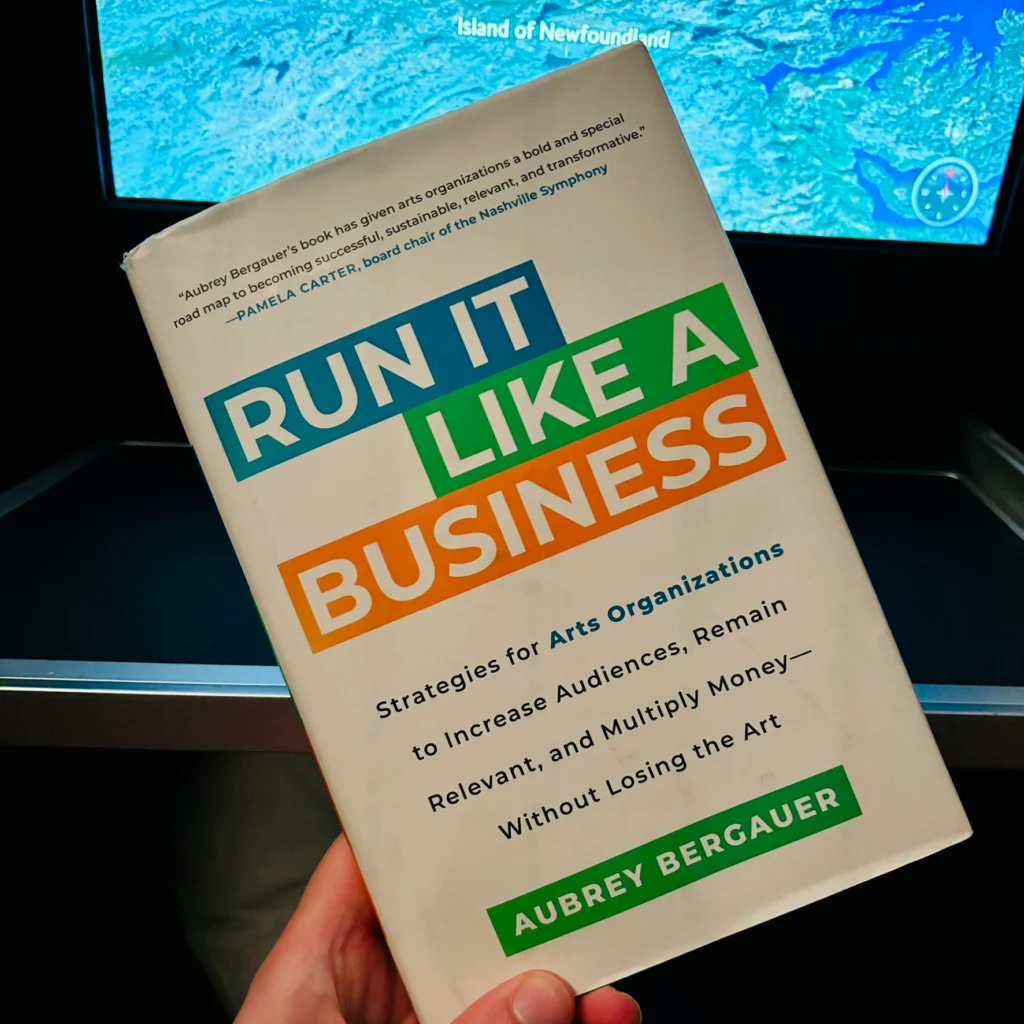
I pre-ordered Aubrey Bergauer’s call to action, Run It Like a Business, and read it in one sitting on a flight from the UK to the US. Many of the insights into smart practice for arts organizations apply far beyond our sector, and I devoured every page.
The title is deliberately provocative. If you work in the arts, what’s your reaction to it? How do you think your team would respond?
Would they be surprised to learn that it’s not about distancing from mission, but delivering on it more effectively? About putting management structures in place that enable people to do their best work — and compensating them fairly for it? About engaging more meaningfully with audiences rather than less?
In other words, it’s about ambition.
Survival doesn’t always feel like a low bar — but it can’t be the goal
Of course arts organizations want to make enough money to survive.
And in a sector shaped by uncertainty, funding pressures, and rising costs, survival doesn’t always feel like a low bar. Sometimes it feels like an achievement in itself.
But if survival becomes the ambition rather than the baseline, we risk settling. And settling does our work, our people, and our communities no favors.
If we’re serious about purpose, then the goal has to be enough to thrive.
Because purpose doesn’t survive on intention alone.
Purpose needs profit.
Labels shape mindsets — and “not-for-profit” is a problem
One of the most limiting ideas in the arts is the quiet assumption that not-for-profit describes who we are, rather than how we’re taxed.
It’s a legal and financial designation — not a mindset, a value system, or an ambition ceiling.
And yet labels shape how we think. When organizations internalize not-for-profit as an identity, it can subtly cap confidence and dampen boldness. Financial ambition starts to feel awkward, even suspect, rather than necessary.
At TLCC 2024, Andrew Recinos highlighted just how misleading this framing can be. Arts and culture organizations must make money in order to thrive. The distinction isn’t whether profit exists — it’s what happens to it.
In our sector, profit isn’t extracted.
It’s reinvested.
In the work.
In people.
In reach.
In resilience.
In the future.
That’s not a contradiction of purpose.
It’s how purpose is sustained.
Thriving organizations can do what surviving ones can’t
Organizations that are permanently in survival mode struggle to:
-
plan beyond the short term,
-
pay people fairly and competitively,
-
invest in skills, systems, and audiences,
-
take creative risks,
-
or respond thoughtfully to change.
That isn’t virtuous.
It’s exhausting.
Thriving organizations, by contrast, have the capacity to think long-term, to innovate responsibly, and to be generous — with time, energy, and imagination.
That’s not mission drift.
It’s mission delivery.
Thriving also means investing in how the work gets done
There’s another place thriving organizations invest deliberately: in the technology that underpins their work.
Too many arts organizations end up muddling through with systems that create friction, duplicate effort, and quietly waste time and energy — all in the name of “making do”.
But making do has a cost.
When processes are clunky and data is fragmented:
teams work around systems instead of with them,
decision-making slows or relies on instinct rather than insight,
opportunities are missed,
and effort is drained from the work that actually serves the mission.
Investing in the right tools isn’t about bells and whistles. It’s about minimizing friction and waste, and maximizing capacity — freeing people to focus on programming, audiences, artists, and impact.
Thriving organizations don’t just work harder.
They work better.
Pride has to be unshakeable
Being proudly profitable isn’t about chasing surplus for its own sake. It’s about holding your nerve and standing behind the value you create.
That pride can’t live only in the finance team or the executive office. It needs to be felt at every level of the organization — in how people talk about their work, how they price it, how they fund it, and how confidently they ask for support.
Arts organizations don’t just deserve to thrive.
Their communities deserve them to thrive.
A better way to frame the conversation
So perhaps the most productive shift we can make as a sector is this one:
From asking whether it’s acceptable to be profitable
to asking what thriving would make possible.
For your people.
For your audiences.
For your mission.
Start the week proud to be profitable — or proud to be on that journey — and check out Aubrey Bergauer’s work for practical, relatable insight into what it really means to run an arts organization with ambition.
Because survival keeps the lights on.
Thriving is how purpose is fulfilled.